
Scott County Court Records After Arrest
Scott County criminal court records are maintained by the Scott County Circuit Clerk for the 7th Judicial Circuit. The official Circuit Clerk page says the office keeps civil, traffic, and criminal case records for Scott County. The Illinois Courts directory lists the Scott County Courthouse at 35 E Market St. in Winchester, phone 217-742-5217, with weekday public hours from 8:00 a.m. to 4:00 p.m. Those court records become important after a jail arrest because Scott County has no jail roster and arrestees may be housed in another county.
The arrest record and the court record answer different questions. The sheriff or outside jail can answer where the person was taken, whether they are still in custody, and what the booking record may show. The court record shows the formal case after the prosecutor files charges. For booking and custody details, use Scott County jail inmate records. For booking photos, use Scott County jail roster mugshots.
Find Court Records After Arrest
Scott County online case lookup is routed through Judici. During research, the direct Scott County Judici page showed a humanity-verification screen, so a normal browser session may be needed. Illinois Legal Aid public instructions describe Judici searches by case number or party name, often in last name, first name, middle initial format. If the search does not work, call the Circuit Clerk or use a courthouse terminal.
- Open the Judici Scott County case search or select Scott County, Illinois from the court list.
- Search by case number when known, or by party name when the case number is not known.
- Open the case number and review the charge list, filing date, history entries, and disposition fields.
- Call the Scott County Circuit Clerk at 217-742-5217 if certified copies, clerk confirmation, or courthouse help is needed.
The Illinois Courts Scott County Courthouse directory lists an e-filing kiosk, self-help computer terminal, internet, printer, law library, free parking, mobile-device allowance, and Rural Mass Transit resource. Those details are useful when online access fails.
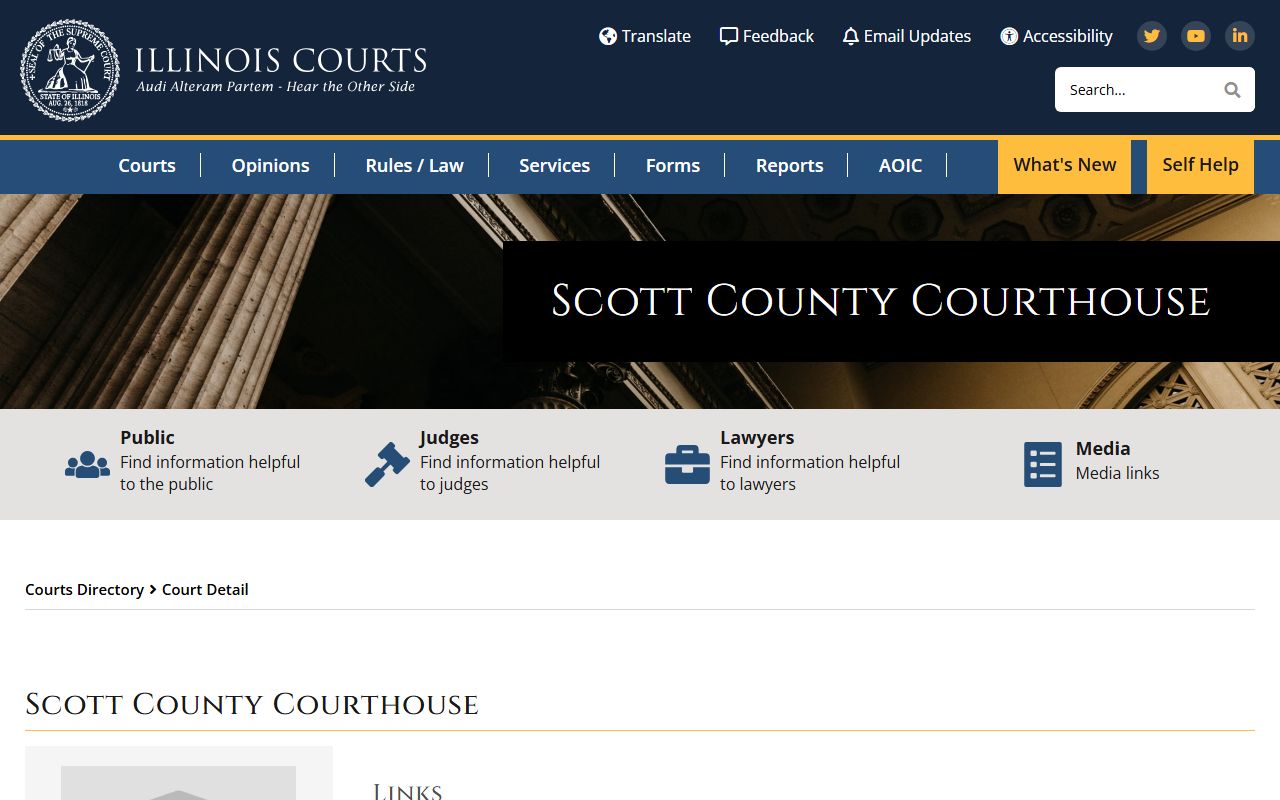
The screenshot below shows the official Scott County courthouse entry used for court-record contact and public-resource details.
Use the clerk for court files and the sheriff or holding jail for jail custody records. The same arrest can generate records in both systems.
Scott County Charges After Arrest
After a Scott County arrest, the State's Attorney reviews the arrest information and decides what formal charge to file. The official Scott County State's Attorney page identifies Richard K. Crews as State's Attorney and describes the office as the county's chief legal officer for criminal prosecutions. A jail booking charge can be a starting label. The court charge is the prosecutor-filed allegation that appears in the court record.
| Document | Who Files It | What It Does |
|---|---|---|
| Complaint | Law enforcement or prosecutor | Starts or supports a charge based on alleged facts after arrest. |
| Information | State's Attorney | Formal prosecutor-filed charging document often used in Illinois criminal cases. |
| Indictment | Grand jury | Formal charge returned by a grand jury, often used in serious felony matters. |
Scott County Court Record Fields
Judici and clerk records are case-record tools, not jail rosters. Once a Scott County case is filed, the court record may show details that the outside jail does not show, including hearing history and final disposition. The public online record should not be treated as a certified court file. For certified copies or expungement paperwork, use the Circuit Clerk.
| Field or Tab | Use for Arrest Research |
|---|---|
| Case number | Stable identifier for court calls, copies, payment, and docket searches. |
| Party or defendant name | Identifies the person charged. |
| Filing date | Shows when formal charges entered the court record. |
| Charge or count | Lists prosecutor-filed charges, which may differ from booking text. |
| History or docket | Chronological entries for hearings, filings, orders, continuances, warrants, and outcomes. |
| Disposition | Outcome such as dismissed, guilty, supervision, amended, or not guilty. |
| Payments | Fines, fees, costs, or balances where displayed. |
| Warrant entries | May show failure to appear, bench warrant, recall, or related events. |
Charge Status in Court Records
Charges can change after the first booking record. The prosecutor may amend, reduce, dismiss, or replace a charge. A case may end by plea, trial, dismissal, supervision, or other disposition. A charge is not a conviction unless the court enters a conviction or guilty finding that has that effect.
| Status | What It Means |
|---|---|
| Pending | The charge is open and no final outcome has been entered. |
| Amended | The charge was changed by prosecutor or court process. |
| Dismissed | The charge ended without a conviction on that count. |
| Nolle prosequi | The prosecutor declined to continue a charge. It is not an acquittal. |
| Supervision | An Illinois outcome that may avoid conviction if completed, but record effects vary. |
| Conviction | A guilty plea, verdict, or finding entered as a conviction. |
Initial Appearance After Arrest
Illinois law ties the jail arrest to the first court event. Under 725 ILCS 5/109-1, a judge at initial appearance informs the defendant of the charge, provides the charge, advises counsel rights, appoints counsel when required, and addresses pretrial release. This is the point where a jail arrest begins to become a court record in a public case file.
Illinois pretrial reform also matters. Under 725 ILCS 5/110-6.1, pretrial detention requires a court process and statutory findings. Since Illinois eliminated cash bail as a condition of pretrial release, old advice about calling a bondsman can be wrong. The court may release a person with conditions, detain the person, or keep the person held because of another warrant or detainer.
Scott County Arrest Warrants
No official Scott County online active-warrant list was located. Warrant research should use the sheriff and court-record channels together. Call the Scott County Sheriff's Office for sheriff-held warrant questions. Search Judici for failure-to-appear, bench-warrant, or body-attachment entries tied to a known case. Contact the Circuit Clerk for court case status and court-issued warrant entries.
- Bench warrant
- A court-issued warrant, often tied to failure to appear.
- Body attachment
- A custody order used in some contempt, payment, or appearance contexts.
- Detainer
- A hold request from another agency that can affect release.
- Failure to appear
- A missed court date that can trigger new court action or a warrant.
Charges vs Convictions
A Scott County court record after arrest may list charges before guilt has been decided. That is normal. The charge is an accusation filed by the State. A conviction is a court outcome after a guilty plea, verdict, or qualifying finding. Treating a charge as a conviction is a serious records error.
| Issue | Charge | Conviction |
|---|---|---|
| Stage | Filed allegation after arrest | Final or entered guilt outcome |
| Who controls it | State's Attorney and court filings | Judge, plea, or verdict process |
| Can change? | Yes, it may be amended, reduced, or dismissed | May be appealed or later affected by sealing law |
| Search meaning | Shows what was alleged | Shows a completed outcome on that count |
Sealed Expunged Arrest Records
Illinois expungement and sealing are governed by 20 ILCS 2630/5.2. Expungement can remove qualifying arrest and charge records from public view in a stronger way. Sealing hides qualifying records from most public access while preserving limited access for courts, law enforcement, and other authorized entities. Eligibility depends on the charge, outcome, waiting period, and prior record.
| Issue | Sealed | Expunged |
|---|---|---|
| Public visibility | Hidden from most public searches | Removed or treated as not publicly existing for qualifying purposes |
| Agency access | Limited agency access may remain | More restricted, but not a promise that every private copy disappears |
| Best contact | Circuit Clerk or legal aid resources | Circuit Clerk or legal aid resources |
Victim Services and Notice
The Scott County State's Attorney page lists victim/witness coordinator Bobbie Jo McKee at 217-742-8907. The office describes its role as prosecuting criminal cases, protecting defendants' rights, using resources appropriately, and attending to crime victims' needs. Victim notification for custody status can also involve VINELink when the person appears in a participating custody system.
Important: Online court records can lag. Call the clerk, prosecutor, sheriff, or holding jail for urgent case or custody confirmation.
Scott County Courthouse Help
The courthouse can matter when Judici is unavailable, a humanity check blocks access, or the online docket does not answer a records question. The Illinois Courts directory lists the Scott County Courthouse with public resources including an e-filing kiosk, self-help center computer terminal, internet, printer, law library, free parking, mobile devices allowed, language access, a lactation room, and Rural Mass Transit. Those resources support court-file access, but they do not replace sheriff or jail custody confirmation.
Certified copies, proof of disposition, expungement filings, and clerk-assisted record searches should be handled through the Circuit Clerk. Jail staff may know whether a person is physically in custody, but they do not certify the court outcome. The same split works in reverse: the clerk may show a filed charge and hearing date, but the clerk is not the source for visitation, inmate mail, commissary, or a current jail housing unit. After a Scott County arrest, accurate records work usually means checking both sides.
Public Record Search
Sponsored Results